Festival of Saint Juliana
Solemn feast to celebrate Saint Juliana, the patron saint of the Val di Fassa, with pilgrimage from the centre of Vigo to the shrine above the village
«Santa Giuliana, antica speme, la Val di Fassa, si entrustarsi a te» says the hymn performed by the parish choir of Vigo on the liturgical feast of 16th February to celebrate the valley's patron saint. The devotion to the martyr saint of Turkish origin, considered the patron saint of childbirth, is enduring and tangible, as demonstrated by the many legacies of the inhabitants of Fassa.
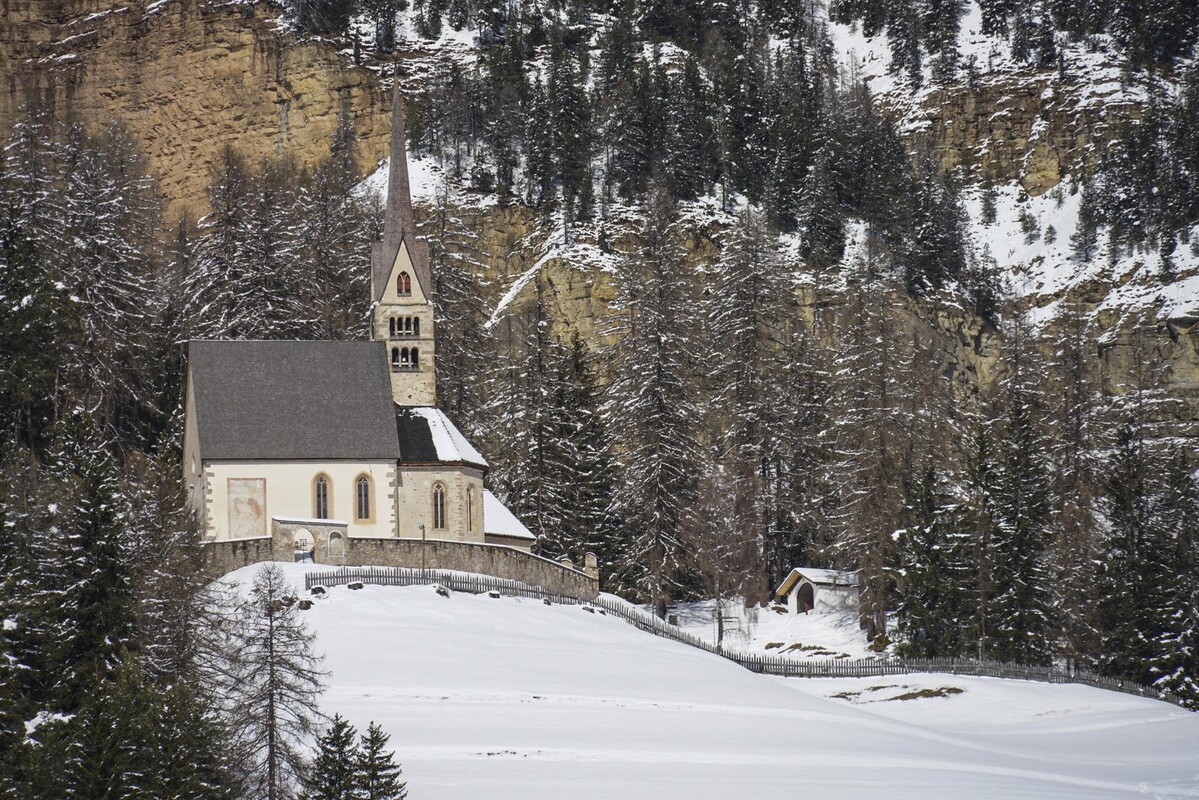
The day opens with a procession leaving at 9.30 a.m. from the former town hall in Vigo (next to the information office) to reach the sanctuary located at an altitude of 1,500 metres on the "Ciaslir" hill where Holy Mass will be celebrated. Following this, the village band "Mùsega da Vich" will sing some songs accompanied by a moment of conviviality with "grostoli" (typical fried sweets sprinkled with sugar) and mulled wine offered by the village's volunteer group.
Inside the Gothic church, whose pointed tip of the bell tower seems to stretch as far as the spires of the Catinaccio, the north wall houses a double cycle of frescoes with captions in the vernacular, which tell the story of St. Juliana, a virgin and martyr in Nicomedia (present-day Turkey) in 305 AD. The young girl, from a noble Roman family, had been promised in marriage to the Roman prefect of the province of Nicomedia, but agreed to grant him her hand in marriage only if he converted to Christianity. He, fearing the fierce persecutions of the Emperor Diocletian, demanded instead that Juliana become a pagan, and had her cruelly tortured to force her to consent. The young girl was able to resist heroically, even to the point of beheading. However, the prefect and his court fell victim to the wrath of God, who sank the ship they were on after these events. It is also said that Juliana, while imprisoned, was tempted by a demon disguised as an angel to pretend to worship the gods in order to avoid death, but the Saint discovered the trick and became so angry with the evil spirit that she bound him and beat him with her chains, dragging him with her to the scaffold. For these reasons, Saint Juliana is depicted with the palm of martyrdom, the sword with which she was killed, the blue and red mantle, symbol of purity and royalty, and a little devil in chains at her feet.